Solar power optimization
Store your solar surplus instead of feeding it back at a lower rate or losing it, so you can use your green energy in the evening too.


Use case - Optimize solar power
Use Bnewable's battery storage to maximize the value of your solar power and reduce your electricity costs from day one.


0 hours
instead of 573 hours of negative electricity prices

More of
your solar surplus used for your site
€0
investment

24/7
automatic control, tuned to your solar installation
If your solar installation produces more than you can use, you're left with two options: sell the surplus at negative prices, or have your system's output capped and lose the surplus altogether, if that's even possible. Either way, electricity that should be free ends up costing you money or going to waste.

Bnewable's battery storage stores your solar surplus so you can use it when you need it. This way, you avoid potential negative prices, reduce how much you draw from the grid, and become less dependent on fluctuating market prices.

We integrate our battery storage with your existing solar installation, without needing to change your setup. With our Battery-as-a-Service model, we also take on the investment, installation, and operation of the battery, so you can stay focused on your core business.
Store your solar surplus instead of feeding it back at a lower rate or losing it, so you can use your green energy in the evening too.

Lower your capacity tariff with a battery that covers your demand peaks instead of the grid, without any change to your operations.

Bnewable's battery takes over when your site needs more power than your grid connection can handle. You get the extra capacity of a grid upgrade, without the years of waiting or the costs that come with it.
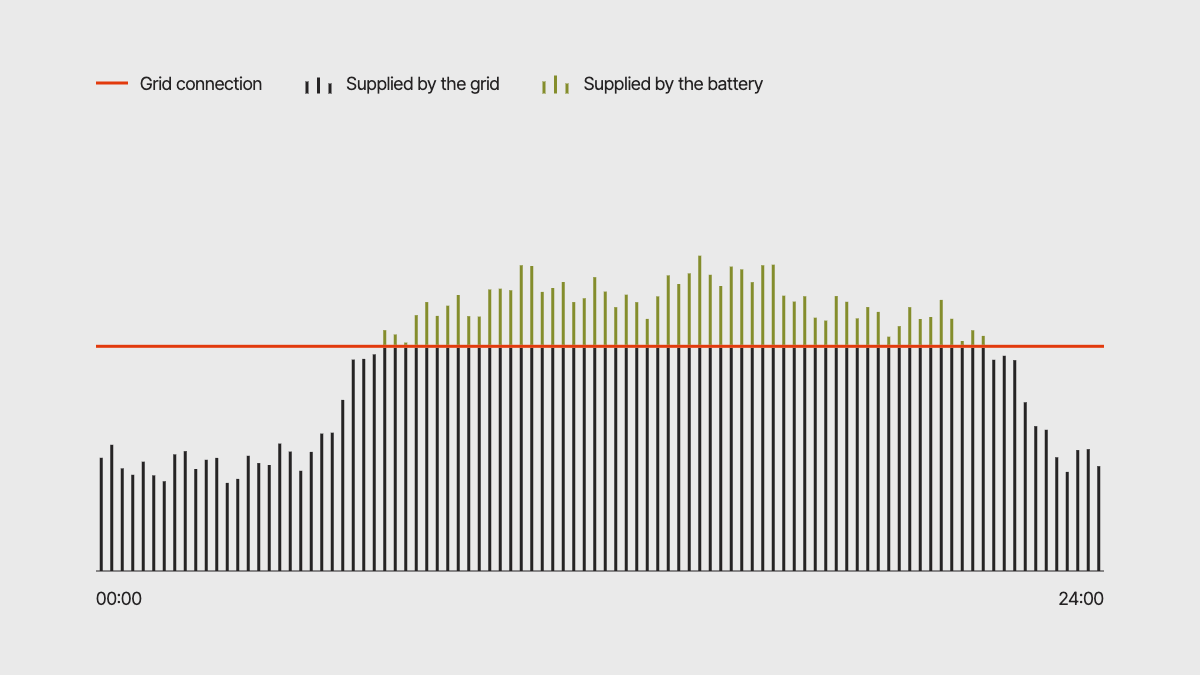
Bnewable's energy management system, Voltana trades your battery's flexibility on the energy markets, adding a revenue stream on top of your savings, automatically.




Virtual grid extension calculation example
When your solar installation produces more at midday than you use, the surplus is often fed into the grid at negative prices, or lost if your system's output gets capped. In the afternoon and evening, when your consumption rises again, you buy that same power back from the grid at a higher price.
Graph
Bnewable's battery storage charges exactly when your solar installation produces more than you use. When your consumption rises again later, the battery discharges. This means you buy less expensive power from the grid.
Graph
Solar self-consumption example
This example shows what solar self-consumption can look like for an industrial company with a 3 MW solar installation and a 2 MW / 4 MWh battery storage. These figures are for illustration only; your actual result depends on your site and specific circumstances.
For 750 hours a year, mainly in summer, the solar installation produces more electricity than the company consumes. Instead of feeding that surplus into the grid at 6 cents/kWh, the battery stores all 218,328 kWh for use in the evening.
Without battery storage, the company would need to draw 218,328 kWh from the grid in the evenings at a consumption price of 21.18 cents/kWh. That's €46,242. Subtracting the €13,100 in forfeited feed-in tariff leaves a value of €33,142 a year. This saving sounds good at first. But relative to the investment required to buy or lease battery storage, it rarely pays off.
If the battery storage was purchased solely for solar self-consumption, the investment of roughly €1.1 million would take 33 years to pay for itself, far longer than the battery's technical lifespan.
The year has 8,760 hours. The battery is only used for solar self-consumption during 750 of them. It would sit idle 91% of the time.
Self-consumption remains a good use case for battery storage — it just shouldn't be the only one. That's why we combine curtailment, peak shaving, and virtual grid extension to maximize the use of your solar installation. And even then, we're often still only at 20% utilization. We trade the remaining 80% for you on the energy market, generating extra revenue on top of your savings.
Testimonial

We chose Bnewable because they genuinely know BESS: it did not feel like a purchase, but rather a partnership where our questions get answered quickly.

Your project with Bnewable follows the Battery-as-a-Service model: you pay a fee only when the battery is actively lowering your electricity costs, and you keep the larger share of those savings. The rest of the time, Bnewable trades on the energy market using your battery, and you get a cut of that too. Either way, you reduce your energy costs and earn extra revenue, with no investment, and no extra staff required.
1
We size the battery to your consumption, peak loads, solar generation, and grid connection, then calculate what you'd save before you commit to anything.
2
Bnewable covers the full cost of the system. You provide the space and the grid connection; your capital stays in your core business.
3
Energy storage comes with complex permitting. We handle planning, permits, and installation, while your operations continue as usual.
4
We keep the battery running at peak efficiency, cutting demand peaks, maximizing your solar use, or earning market revenue. Maintenance is on us too.
Not automatically; that depends on the size of your battery storage system. When the battery is full, or the surplus is larger than what it can take, the remainder flows to the grid as it does today. Bnewable sizes the battery storage system against your measured surplus, so the share you capture is as high as it can usefully be.
Yes, solar surplus is only one of the battery storage system's jobs. The battery cuts your capacity tariff by shaving your consumption peaks, and it earns separately by trading: charging when wholesale prices are low and discharging when they're high, independent of any solar surplus. Solar adds a third revenue stream on top of these two.
Lorem ipsum dolor sit amet. Ad velit accusamus ea reprehenderit blanditiis quo repellat exercitationem a illum similique. Qui modi reiciendis est veniam fugit ut voluptas asperiores id sunt alias rem animi autem vel laudantium nobis.
Lorem ipsum dolor sit amet. Ad velit accusamus ea reprehenderit blanditiis quo repellat exercitationem a illum similique. Qui modi reiciendis est veniam fugit ut voluptas asperiores id sunt alias rem animi autem vel laudantium nobis.
Spreads do compress as more batteries come online, and that has already happened in the Belgian balancing markets since large-scale storage arrived. Two things work against it: 1) a battery storage system behind-the-meter earns from your own bill as well as from the market, and 2) that saving grows as grid costs rise.
Contact us to explore how Bnewable's battery storage can help you get the most out of your solar installation.